
The Presence of Absence: A Journey to Document Libya's Last Jewish Fragments
An urgent effort to bottle up the last physical fragments of Libya’s 2,500-year-old Jewish civilization before the country’s turmoil buries them for good.

📍 Libya
Libya is caught in a cruel cycle of total reset. Because its history is a series of violent transitions, each new era feels the need to bury the one that came before it to prove its own legitimacy. I saw this first with the “Gaddafi erasure” — the way a despot who ruled for 42 years has been scrubbed from every signpost and monument, his name now relegated to rare, hushed mentions. I saw it also in the city center, where Italian colonizers chiseled a Fascist “New Rome” into the old Ottoman neighborhoods, only for those grand cathedrals to be stripped of their crosses and turned into mosques the moment the colonial era ended. Even Libya’s geography participates in this often vicious cycle of reinvention: the Sahara’s moving dunes once swallowed Leptis Magna, the world’s most expansive Roman ruins, keeping them hidden and preserved for centuries.
But Libya’s ultimate act of burial, and the one that required the most concerted scavenger hunt to declutter, was its Jewish history. What remains is the presence of absence — fragments of a community that existed here for 2,500 years that barely allowed to leave behind a trace.


Libya holds a somber distinction it will soon share with Iraq (with 1 Jew officially left in Baghdad) and Syria (where around 6 elderly Jews in Damascus remain): it is the only Arab country where a biblically ancient diaspora is entirely extinct (with the possible exception of Sudan). Unlike neighboring countries who keep token heritage sites in tact for their rump and aging communities, Libya has attempted to zero out its Jewish history. This wasn’t a slow departure; it was a violent crescendo that began with Nazi occupation and ended with their expulsion in 1967, when they were conspiratorially implicated in the Israeli-Arab Six Day War thousands of miles away. Under Gaddafi, the erasure became systematic: cemeteries were paved over for parks, and synagogues were repurposed into mosques, offices, and even parking lots.
This was not a journey of open inquiry, but a masked mission of memory. To document these sites in a land where their very existence is a taboo required a strategic discretion and feigned disinterest. Because all of Libya’s few tourists must be escorted by armed police to approved sites, I had to feign a total lack of interest in the very things I was looking for. I referred to ancient synagogues — unlabeled on maps but verified through accounts from the exiled community — as old “churches.” To refer to sites as are (or were) would have ended the expedition instantly.
The itinerary itself was a coded game. My escorts carried a stack of printed authorizations that dictated our every move; I wasn’t even allowed to have a private dinner with a graduate school friend living in Tripoli. All forms of spontaneity was locked down. I had to design our route so we would incidentally pass by the locations Gaddafi had tried to bury.
Before 1948, nearly a quarter of Tripoli was Jewish. Today, seeing any trace of their over two millennia-old presence requires an exhaustively researched and clandestinely executed scavenger hunt. Locals who live in the former Jewish quarter today are either not actively aware of its recent past, abetting its erasure, or too afraid to speak of it. What I managed to find felt like a miracle of survival against decades of state-sponsored desecration.
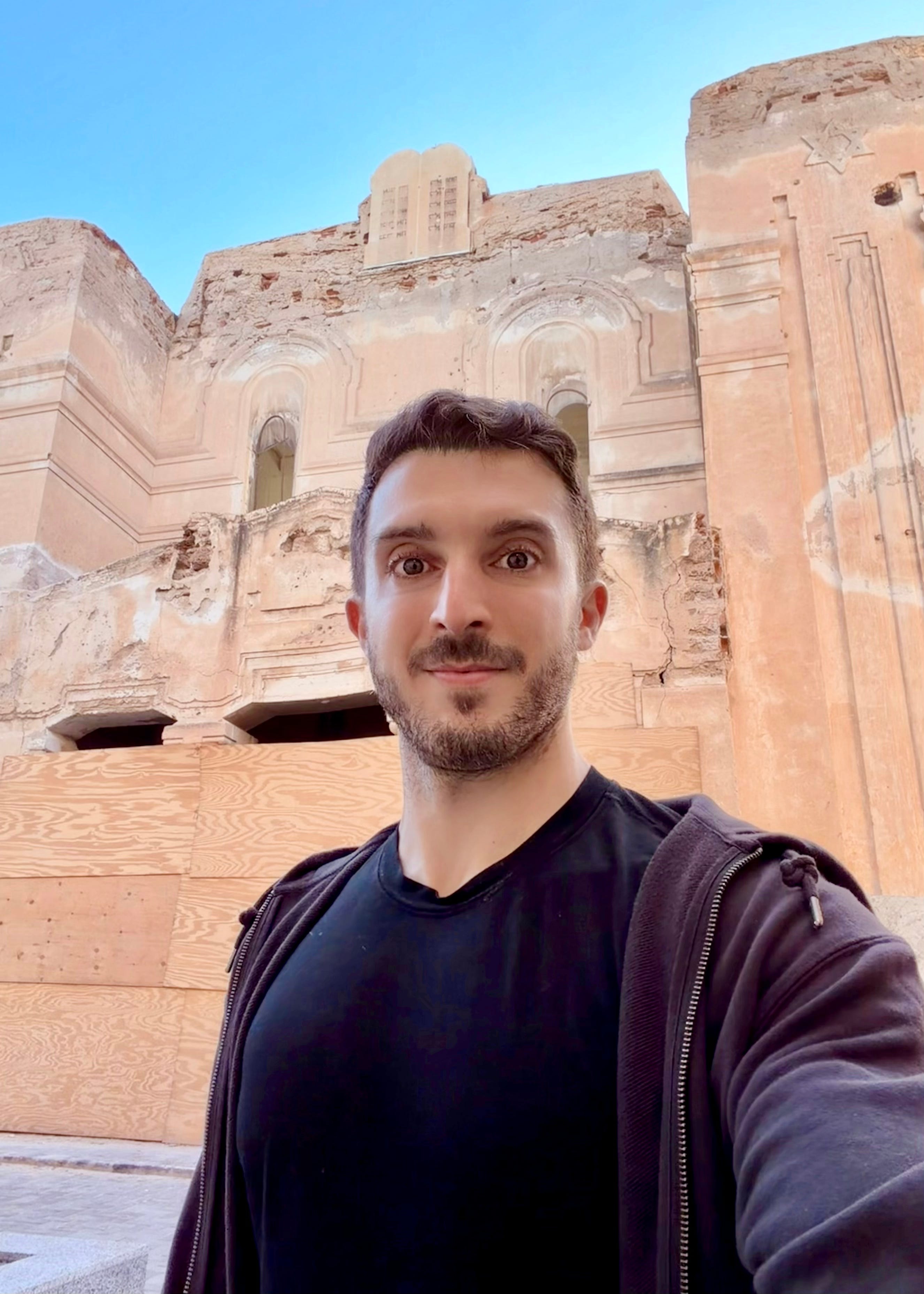
The most impressive survivor is the Grand Dar Bishi Synagogue. Built in 1770, it was once the centerpiece of the quarter. Today, it is a boarded-up stone ghost looming over a labyrinthine alley. It is a structure in limbo, dangling between its sacred past —with Stars of David and Ten Commandment reliefs stubbornly intact despite bullet holes and neglect — and a precarious future, with recurring plans by authorities to convert the structure into an Islamic center.
I wanted to stand at Dar Bishi and imagine it before abandonment, war, and neglect, but at this highly intentional “accident” of a stop, I could not pause for more than a few seconds under the watchful eyes of my required escorts. Witnessing the building, currently awaiting final condemnation, had to be done with light feet, a heavy heart, and an air of feigned indifference.
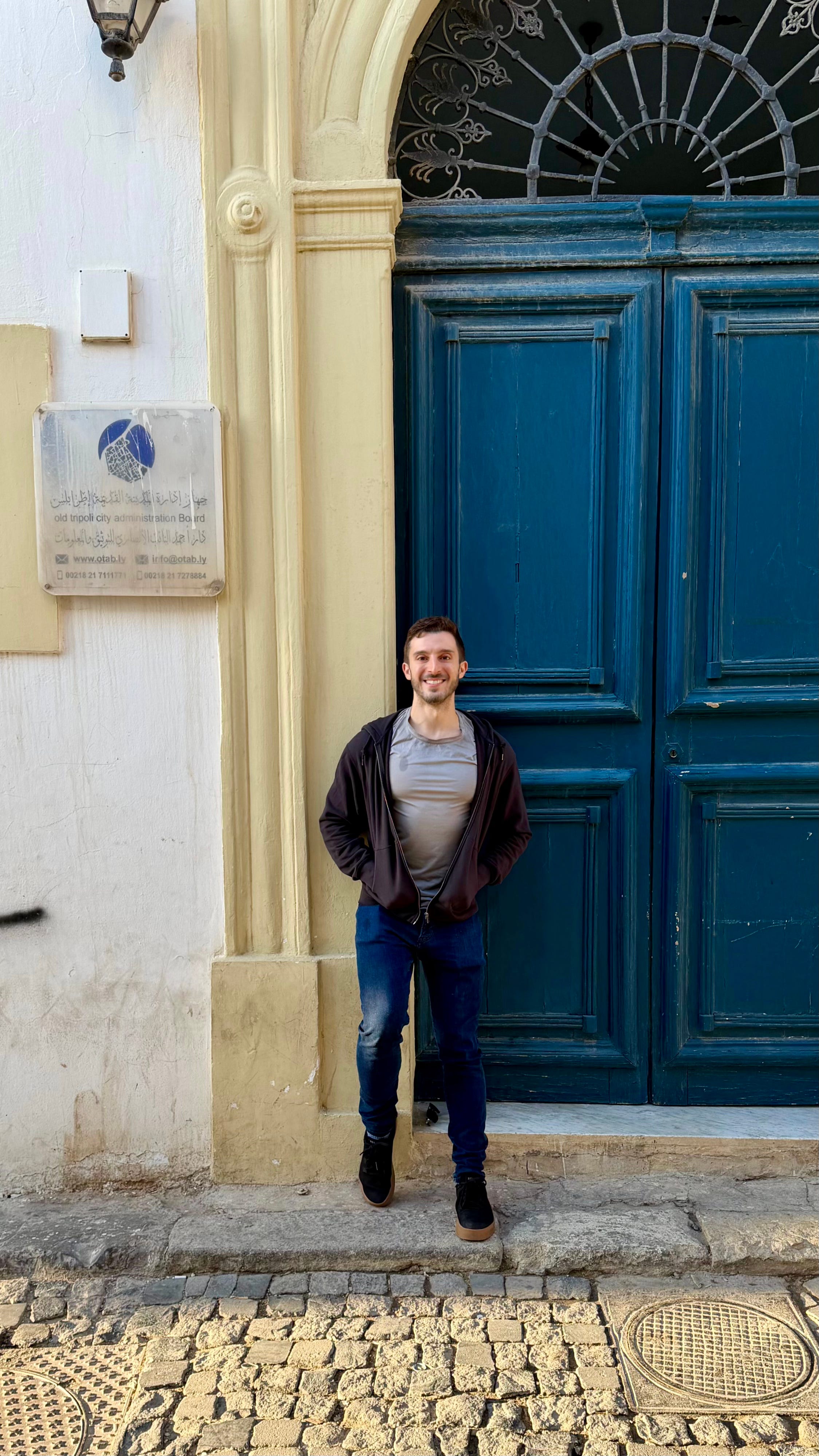
In the surrounding streets, the scavenger hunt for the “ghosts” of former Jewish homes, yeshivas, and storefronts intensified. Spotting each site required both an intense eye and performed nonchalance. All the buildings had taken on new post-1967 lives, with one exception: a small red plaque that read “Jewish school” in Arabic on the former building of Yeshiva Dar Seroussi, now the Old Tripoli City Administration Board.
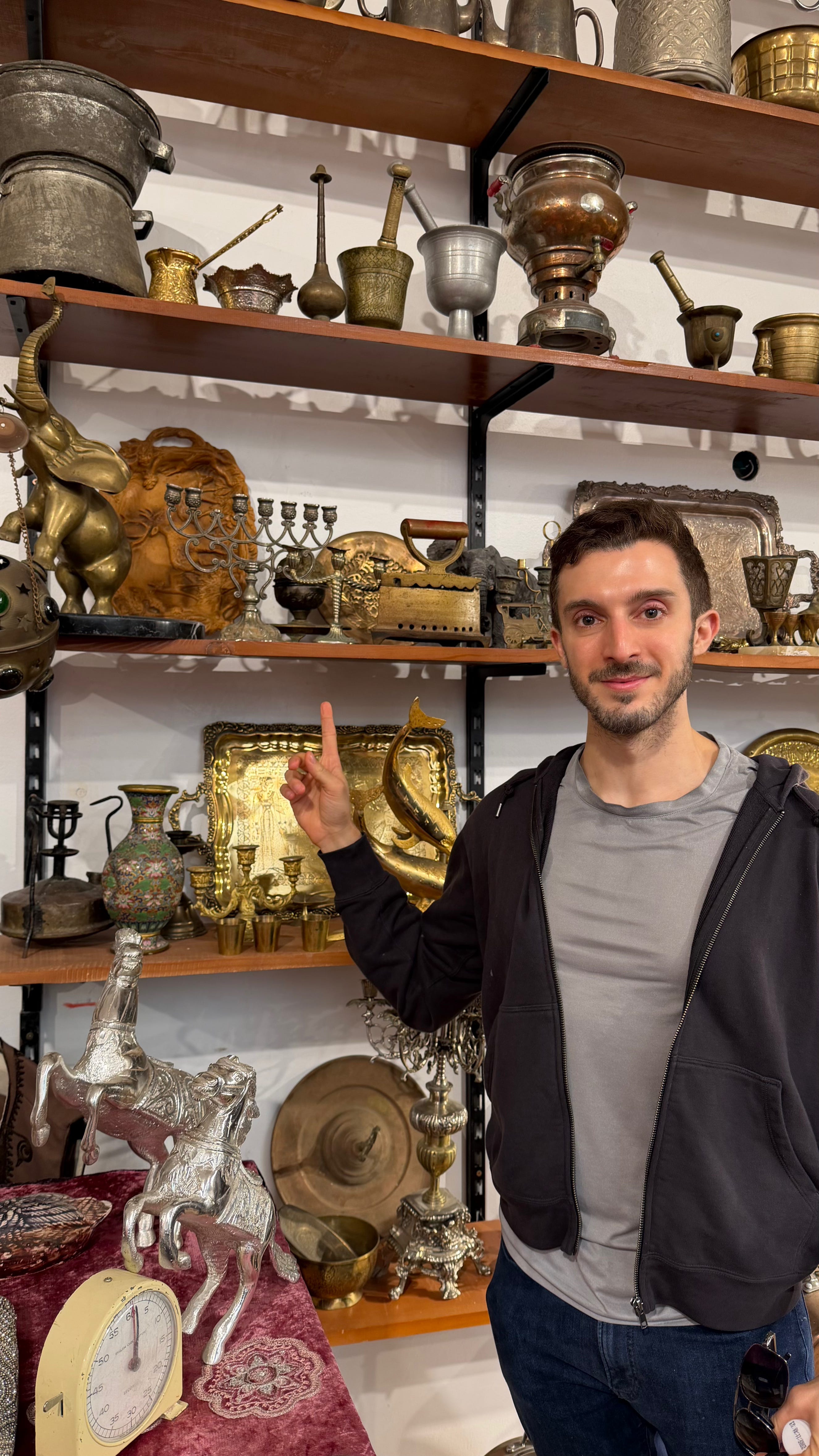
The most visceral proof of this lost world, however, was in the antique stalls of the medina (old city). Tucked under piles of brass junk, I found orphaned menorahs and weathered shofars — the debris of a civilization that left in a hurry, sold by vendors who no longer knew what these objects were. Hold a silver menorah in a Tripoli felt like the ultimate glitch in the systematic erasure.
The exception to these scattered fragments is Tripoli’s World War II cemetery. In a state that teeters between “failed” and “failing,” this site is unquestionably the most immaculately watered and mowed plot of grass in the country. It was here, in this non-denominational and internationally funded military cemetery, that I happened upon the last two undisturbed Jewish tombstones in Libya. While nearly every headstone bore a cross and a handful featured the shahada (the Islamic declaration of faith), two bore the unmistakable six-pointed star: N. Spivack (The Black Watch, died January 24, 1943, at age 22) and G.W. Oppenheim (General List, died March 18, 1945, at age 38). There is a profound, bitter irony in this: the only Jewish names preserved with dignity in Libya are those of the dead who fell in a foreign uniform. They are safe only because they are part of a larger, global story of war, not over two millennia of presence.
From Libya’s coast, I ascended into the rugged Nafusa Mountains to the Berber village of Yefren. This was once a place of deep, long-lost synthesis, where Jewish and Amazigh cultures intertwined so tightly that they often intermarried, eventually birthing a unique, now-extinct hybrid of Judeo-Arabic and local Amazigh. At its height, Yefren was over half Jewish — a community of cave-dwellers and mountain-watchers who had inhabited one of North Africa’s oldest Jewish settlements since the destruction of the Second Temple.
Hidden here is the Qabiliya Synagogue, a site that predates Christianity by centuries: it is absent from maps and vaguely labeled on the structure itself. Even my guide, with thirty years of experience, and the local tourist police had never heard of it. Qabiliya is likely the second-oldest standing synagogue in Africa, housing Hebrew inscriptions that date back more than 2,200 years. Its interior is a haunting series of cave-like chambers, filled with haphazardly etched and unpolished Hebrew scripts. I hadn’t expected to gain entry to the padlocked building, especially since most locals — having lived in Yefren their entire lives — dismissed it as nothing more than a derelict storehouse.
But our curiosity sparked theirs, and eventually, the local Berber caretaker with the key showed up. He let us into the old “church,” as he called it, even though Jesus was over 200 years away from being born when it was built. I nodded in silent agreement, knowing that in today’s Libya, the truth is a liability to this ancient structure. Perhaps calling this synagogue a “church” is a necessary fiction that keeps it from being vengefully pulled off life support.
The caretaker and I surprised each other: I was shocked that he seemed not to know the language of the wall carvings, and he was amazed that I showed up as the first visitor unaffiliated with the antiquities authority that he had granted access inside in “over a decade.”

My final stop was Jadu, a nondescript town overlooking a giant plateau in the Nafusa Mountains. During WWII, this was the site of the largest Nazi concentration camp in North Africa. Today, it serves as the starkest example of a narrative being written out of national narrative. There is no monument and no plaque to mark where thousands of Libyan Jews were sent to face starvation and typhus. The town deceptively resembles any other in Libya — a reminder that the deepest scars are often the ones left unmarked.
Documenting these final traces of Jewish life in Libya forced me to reflect on the cruelly intentional nature of exile. Civilizations do not simply vanish; they are systematically edited out of the national narrative. To stand at these sites is to realize that we are the last generation of witnesses — and that most of what I recorded here is unlikely to survive the decade. By the year, the presence of absence is becoming harder to witness.